
A compelling investment idea, solid financials – and yet the bank still says no? For many small and medium-sized enterprises (SMEs), this is a daily reality when it comes to financing new equipment or a climate-friendly business model. Yet the sustainable transformation of SMEs is crucial for climate protection, competitiveness, and the resilience of the German economy. Small and medium-sized enterprises (SMEs), in particular, face fundamental hurdles when it comes to financing. A recent policy brief by the Sustainability 2030 Science Platform (wpn2030), the Wuppertal Institute, and the Sustainable Development Solutions Network Germany (SDSN) analyzes the key bottlenecks and identifies three practical solutions.
The Starting Point: Key Challenges in Transformation Financing
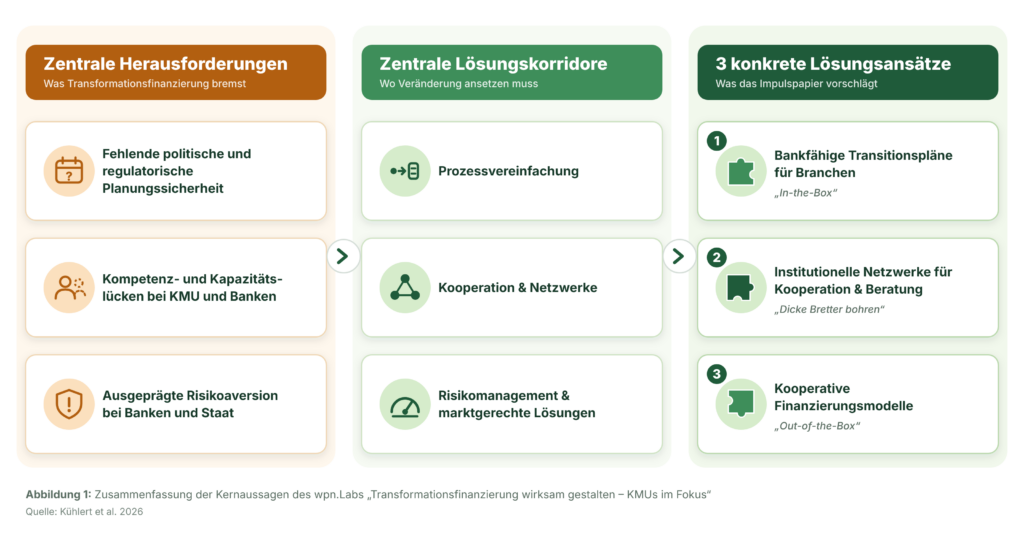
Although SMEs recognize the need for environmental investments, in practice they often face business constraints. Empirical studies and the findings from a transdisciplinary study conducted by wpn.Labs1 show that closing the investment gap is hindered primarily by three structural barriers:
- Lack of planning certainty: Constantly changing regulatory and political conditions make it difficult to perform long-term business calculations.
- Skills and capacity bottlenecks: Both companies and banks often lack industry-specific and scientifically sound expertise in assessing environmental risks and opportunities. In addition, these gaps in expertise, combined with relatively small loan volumes, result in high transaction costs.
- Pronounced risk aversion: High transaction costs for relatively small loan amounts ("small tickets“), as well as the lack of established markets, are causing banks to exercise caution.
To address these challenges, targeted policy instruments and closer coordination among stakeholders from the financial and real sectors are needed. The position paper identifies three specific approaches to this end:
1. Bank-ready transition plans for industries ("In-the-Box“)
The collection of sustainability data – for example, through the European Standard for Voluntary SME Reporting (VSME, known as the VS Standard starting in 2026) – should be systematically linked to the requirements of the credit processes. Regulatory requirements reinforce this need: The EBA guidelines on ESG risk management have been in effect since January 2026; smaller institutions must implement them by January 2027 at the latest. To do so, banks need reliable data, including from their small and medium-sized enterprise (SME) clients. Standardized, industry-specific blueprints enable SMEs to translate their transformation paths into traditional business plans in a structured manner. This provides banks with reliable, comparable ESG metrics for their creditworthiness and risk assessments. This reduces transaction costs, increases planning certainty, and facilitates the granting of – or access to – sustainable impact bonuses.
2. Institutional Networks for Cooperation and Consulting ("Tackling Tough Challenges“)
Business model innovations or major equipment upgrades require regional and supraregional networks that offer consulting, financing, and funding all under one roof. By pooling resources and facilitating knowledge transfer among industry associations, development banks, and the real economy, economies of scale can also be achieved – such as lowering barriers to accessing small-scale grants. Such institutional networks have the potential to shift the SME paradigm so that SMEs are recognized as independent drivers of innovation in the transformation process and are not merely viewed as laggards behind large corporations. In addition, the authors of the position paper advocate for changes to the regulatory framework, such as adjustments to risk assessments (e.g., MaRisk or Basel III) and incentives such as the ECB’s green TLROs or contracts for difference.
3. Cooperative Financing Models ("Out-of-the-Box“)
For capital-intensive projects with long payback periods – such as waste heat recovery or cross-company circular infrastructure – conventional debt financing models often reach their limits. One potential solution is the establishment of regional financing cooperatives composed of local stakeholders. Rather than focusing on short-term monetary profit distributions, this structure emphasizes immediate economic synergies, such as discounted energy rates for participating members. Surpluses remaining after the payback period can be used directly to reinvest in further regional transformation projects in accordance with an agreed-upon roadmap.
Conclusion: Transformation as a Collective Endeavor
The analysis shows that the transformation of small and medium-sized enterprises (SMEs) cannot be achieved through government support programs alone, nor through traditional bank loans. What is needed are market-based instruments, simplified data exchange, and a stronger culture of cooperation between the real economy and the financial sector. Through targeted de-risking, the elimination of information gaps, and bold forms of collaboration, SMEs can fully realize their central role as drivers of innovation and the backbone of a sustainable economy. A first practical step: structuring their own sustainability data using the VS standard.

Author: Markus Kühlert, Co-Director of the Business, Finance, and Training Research Group in the Sustainable Production and Consumption Division at the Wuppertal Institute
About the Position Paper
The Complete position paper "Designing Effective Transformation Financing for SMEs – Challenges and Potential Solutions“ serves as a scientific basis for discussion to further advance the dialogue between politics, business, and academia. The discussion paper was authored by Markus Kühlert, Dr.-Ing. Jens Teubler, Prof. Dr. Christa Liedtke, Dr. Axel Berger, and Sarah Löpelt, and was published by the Science Platform for Sustainability 2030 (wpn2030).

