
Martina Altheim has been responsible for sustainability management at the q.beyond AG and is also committed to the sustainable development of the company as a member of the Supervisory Board. The company is one of the leading IT service providers and solves the technological challenges of medium-sized companies. In an interview with Steven Rohles from iron, Martina Altheim explains why resilience and sustainability are two sides of the same coin for her, how the „resilience house“ she developed works as a strategic management model and why the digital product passport is far more than just a compulsory regulatory exercise.
Steven Rohles: Ms. Altheim, you have been with q.beyond, formerly QSC, for almost 20 years. How did you personally become interested in sustainability - was it a conscious decision or more of a coincidence?
Martina Altheim: Sustainability has been a recurring theme throughout my entire professional career. Even during my biology studies, I was involved in public relations work for species conservation at Cologne Zoo. After further training in environmental and quality management, I then helped to set up an environmental management system as a trainee in a mechanical engineering company. Later, I worked for many years as a business process manager at „Der Grüne Punkt“ in the circular economy.
At q.beyond, my roles in business process management and quality management then led me to where sustainability is practically anchored today: in control, processes and management logic - and ultimately to my current role. I see sustainability less as a „technical corner“ and more as a management-relevant perspective on corporate future viability.
Steven Rohles: q.beyond is an IT service provider. At first glance, that sounds like a business model that has less to do with sustainability than other sectors...
Martina Altheim: I actually hear that a lot, but the opposite is the case. Digitalization and artificial intelligence are no longer an optional extra, but a must for the future viability of companies. However, digitalization not only brings opportunities, but also risks: cyberattacks are on the rise and IT energy consumption is increasing rapidly. This is becoming a cost driver - and worse still, it is fueling climate change.
So the key question is: how can companies grow digitally without jeopardizing our future? The answer is: they need sustainable IT solutions. Sustainability combines two key aspects - digital sovereignty, i.e. security and control over your own data, and ecological resilience, i.e. IT that is energy-efficient and can withstand climate change. Only the combination of both aspects creates real resilience. For me, resilience is therefore synonymous with sustainability.
Steven Rohles: That sounds exciting. Can you explain to us in more detail how q.beyond implements these two aspects in concrete terms?
Martina Altheim: We support companies on two paths into the cloud: firstly, into the public clouds of large international providers. The second is our own sovereign private cloud with integrated AI applications, TÜV and ISO-certified and operated in our own data centers in Germany. For anyone who wants to remain independent, this is data sovereignty in action - including cyber security.
These data centers are also climate-friendly. We were one of the first medium-sized IT service providers in Germany to sign up to the EU Code for Energy Efficient Data Centres and have implemented almost all of its 150 or so recommendations - from energy-efficient hardware and server virtualization to the needs-based design of our IT services. We have been using our biggest lever since 2018: 100 % green electricity in all data centers. We are also equipping our infrastructure against the consequences of climate change, for example with recoolers that can withstand outside temperatures of up to 45 degrees. The fact that we are on the right track with these measures is confirmed by the German Sustainability Award 2026 in the „IT service provider“ category.
Steven Rohles: In the past, you developed your own model, which you call the „resilience house“. Can you tell us more about it?
Martina Altheim: The resilience house is a strategic thinking model that helps us to make complex interrelationships tangible. It describes resilience not only in financial terms, but also as a combination of economic stability, robust processes, committed employees, an adaptable portfolio and a consistent customer focus. Sustainability or ESG is not an „extra“, but part of the foundation.
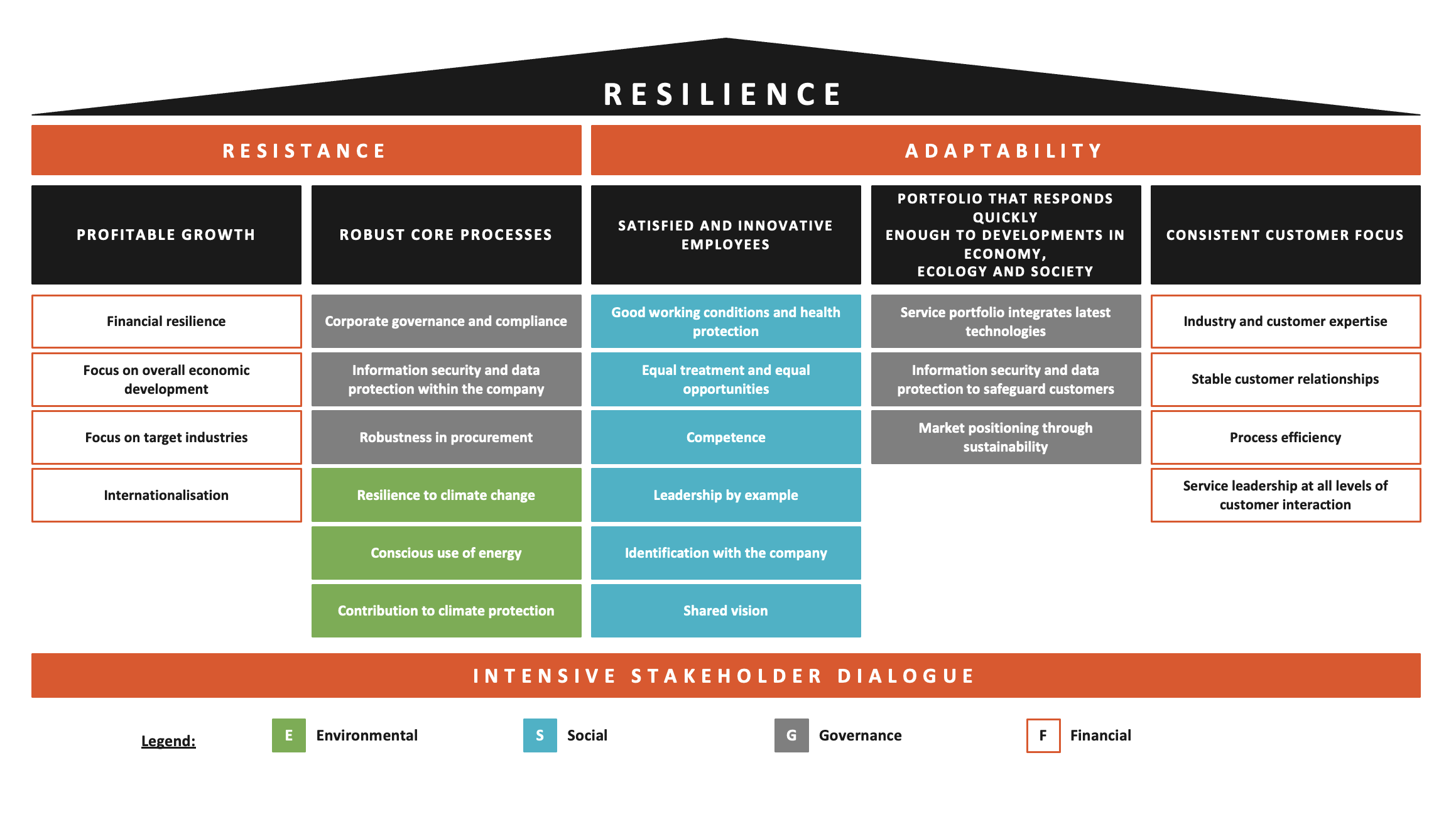
Steven Rohles: In the Resilienzhaus, you combine financial and non-financial aspects under one roof. How did the strategic process of dovetailing these dimensions so closely work and how did you manage to anchor topics such as climate protection as an equal pillar alongside the financial aspects?
Martina Altheim: By consistently linking the dimensions together, not as „soft factors“, but as what they are: genuine prerequisites for long-term performance. We asked ourselves what makes our business model sustainable in the long term. As a result, employee and customer satisfaction, innovativeness and adaptability became clear control variables and thus automatically part of normal management decisions.
Steven Rohles: So you've cracked the code that so many ESG managers are working towards to convince management of the importance of ESG?
Martina Altheim: I believe less in the one „code“ and more in good translation work. ESG is convincing when it answers very specific management questions: How do we remain competitive? Where do risks and, above all, opportunities arise? How do we secure our future viability? As soon as ESG is understood in this way, it is no longer a special issue, but part of good corporate governance.
We have recognized this at q.beyond. For some years now, the resilience house has also served as the basis for short- and long-term ESG targets in the Executive Board remuneration system, anchoring sustainability even more firmly in our strategy. This is measured using key figures along our key sustainability aspects.
Steven Rohles: What would you say to board members or managing directors who see resilience primarily as a financial issue and dismiss ESG aspects as a „nice to have“?
Martina Altheim: Financial resilience is of course important - but it is rarely just about numbers. Ultimately, it is the result of robust processes: climate-resilient and energy-efficient, secure information and data, stable compliance and procurement. Added to this are qualified and motivated employees, the ability to innovate, an adaptable portfolio and a consistent customer focus.
In practical terms, this means that those who do not have answers to rising energy prices, supply chain risks or the shortage of skilled workers today will feel the effects tomorrow in terms of costs, supply capability and growth. ESG helps to address precisely these issues systematically and at an early stage. For me, ESG is therefore less of an „add-on“ and more of an early warning and management system for corporate resilience and therefore something that is later reflected very specifically in the balance sheet.
Martina Altheim
„If you don't have answers to rising energy prices, supply chain risks or the shortage of skilled workers today, you will feel the effects tomorrow in terms of costs, delivery capacity and growth.“
Steven Rohles: The „Adaptability“ section of your resilience house includes the requirement that the product portfolio must react quickly to developments in the economy, ecology and society. This is where the „digital product passport“ comes into play. What exactly is behind this and why is it so relevant for your company?
Martina Altheim: The Digital Product Passport (DPP) is an example of a fundamental change that the EU Ecodesign Regulation away from linear economic models, in which products become waste at the end of their life, towards a genuine circular economy. Products can be repaired and therefore used for as long as possible, raw materials remain in the system and can be reused. This should be transparent and traceable throughout the entire life cycle. The EU is thus pursuing the goal of making sustainable products the standard and keeping raw materials in the economic cycle in the long term.
This is about far more than regulation. After all, the availability of raw materials is increasingly becoming a strategic power factor. As a digital extension of a physical product, the digital product passport creates transparency about materials, origin, carbon footprint and circularity. This makes it a key instrument for adaptability, competitiveness and resilient business models. To implement this, companies need IT solutions and the corresponding IT expertise, for example for data orchestration - and this is precisely where our strengths lie: With our portfolio, we can provide our customers with targeted and needs-based support during implementation.
Steven Rohles: How does q.beyond specifically support companies in introducing a Digital Product Passport - and what does this have to do with ESG data?
Martina Altheim: With the Ecodesign for Sustainable Products Regulation (ESPR) The EU has already set a clear framework, but the specific requirements will come step by step via dedicated legal acts and must then be implemented promptly. We support our customers in preparing for this in the best possible way: with a resilient data foundation, clear processes and a scalable architecture.
Thanks to our various service segments, we cover the entire value chain: from data strategy and the integration of ERP, PLM and supply chain systems to audit-proof provision and hosting in sovereign German data centers. In this way, the digital product passport becomes a permanently operable platform solution instead of a one-off project.
The link to ESG data is close: a lot of information on materials, origin, carbon footprint or circularity is being consistently recorded on a product-related basis for the first time. This means that our customers not only meet regulatory requirements, but also gain reliable data for management, reporting and circular business models.
Steven Rohles: How do you see the Digital Product Passport interacting with other ESG-related EU regulations?
Martina Altheim: We are already supporting our clients with the digital implementation of other ESG-related product regulations such as the „Packaging and Packaging Waste Regulation“ - PPWR for short. It is important not to view these solutions as isolated solutions, but to think holistically and with a view to the Digital Product Passport. This is because these data models are already an expandable foundation for the DPP. In the future, the Digital Product Passport will become the implementation mechanism for product regulations.
In our view, there is no standard solution, as requirements can vary greatly depending on the industry, product range, relevant regulations and system landscape.
Steven Rohles: If you could give one piece of advice to a medium-sized company that is currently stuck between regulatory frustration and sustainability ambitions - what would it be?
Martina Altheim: Understand sustainability not as a pure compliance task, but as a lever for better decisions. If you set up processes, data and responsibilities properly, you will automatically meet many regulatory requirements. The decisive factor is not perfection, but a focus on what makes your own business model truly resilient and therefore fit for the future.
It is also important not to view sustainability as a purely EU issue. Transparency and sustainability are becoming increasingly important worldwide, for example through sustainability reporting in China and digital product and supply chain requirements in other economic areas. The digitalization of ESG data is therefore a key success factor, especially for internationally active companies. It creates comparability, scalability and a basis for decision-making across national borders. Companies that adopt a data-based and integrated approach to sustainability today not only reduce regulatory frustration, but also strengthen their own future viability.
Steven Rohles: Ms. Altheim, thank you very much for the interview.
Martina Altheim
Martina Altheim is Head of Corporate Social Responsibility at q.beyond AG and a member of the IT service provider's Supervisory Board. She studied biology and completed further training in environmental and quality management. Her first professional positions were in public relations at Cologne Zoo and in the development of an environmental management system in the mechanical engineering industry. She then worked for many years as a business process manager at „Der Grüne Punkt“ in the recycling industry. For almost two decades, she has held responsible roles in business process management and quality management at q.beyond (formerly QSC); she has been responsible for the Group's sustainability management since 2020. She is also a member of the company's Supervisory Board and is committed to sustainable corporate development.

