
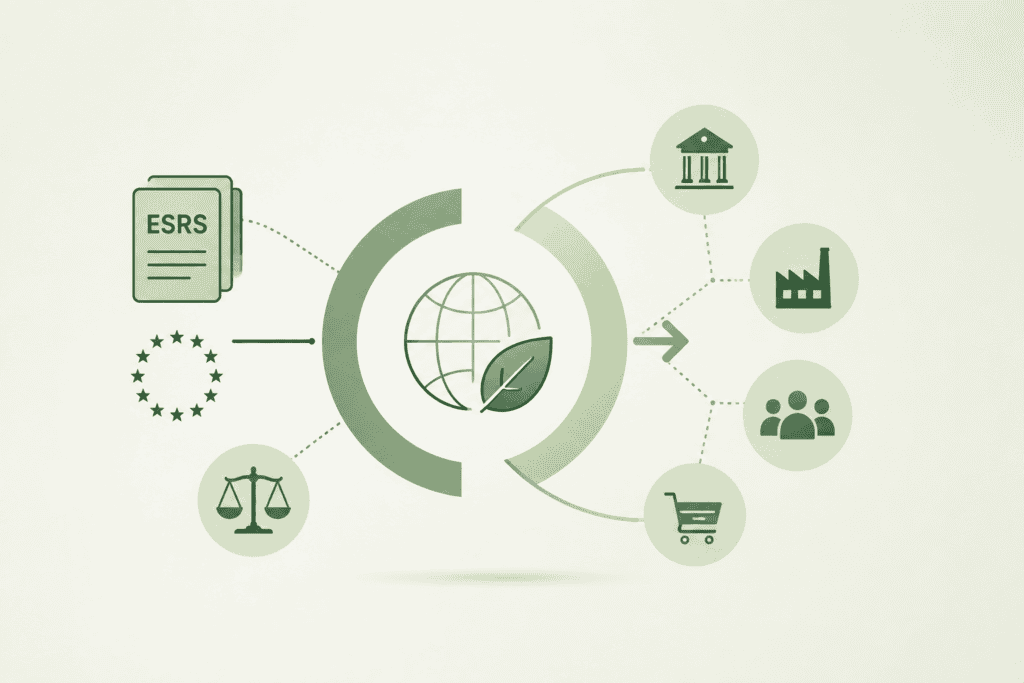
There have been a number of regulatory developments this summer. In early July, the European Commission published the revised standards for sustainability reporting (ESRS) via a Delegated Act. Companies now have clarity regarding future reporting requirements. At the same time, the the Voluntary Standard (VS) provides a binding legal framework: It is aimed at companies not subject to CSRD requirements and, at the same time, sets an upper limit on the ESG data requests that may be made of them. And under the EmpCo Directive, the information included in the sustainability report must later be verifiable in marketing materials.
Reporting required starting in 2027: It’s time to start preparing
For companies that will be subject to CSRD reporting requirements for the first time starting in fiscal year 2027, the final version of the revised ESRS has marked the starting point: They now know exactly which metrics they must report. The report is just the tip of the iceberg. Beneath it lies the real challenge: ensuring reliable data, sound processes, and clear lines of responsibility – often across multiple subsidiaries. Quantitative data on energy consumption and greenhouse gas emissions, in particular, cannot be collected overnight; they require robust processes that must first be defined and embedded within the organization. The remaining months until January 2027 provide exactly the right window of opportunity for this. We have identified the key elements that are crucial for preparation: presented in a webinar in early July 2026.
The reporting requirement ends, but the data requests do not
And what about companies that are no longer subject to CSRD reporting requirements after the EU-Omnibus? For them, the reporting obligation ends – but the market’s requests for data do not. Starting in January 2026, banks must incorporate ESG risks into their lending decisions, as required by the guidelines of the European Banking Authority (EBA). Major clients who themselves remain subject to CSRD reporting requirements also demand ESG data from the supply chain, and in some cases, sustainability assessments such as the EcoVadis rating. Companies that wish to continue following a voluntary framework can do so under the Voluntary Standard, which is intended for companies with up to 1,000 employees. Compared to its predecessor, the VSME, not only have some data points been removed – more importantly, the Voluntary Standard now has a binding legal framework for the first time. This includes the so-called “value chain cap,” a statutory upper limit: Groups subject to CSRD reporting requirements may not demand more data from smaller companies than is covered by the VS.
Whether this cap actually provides protection in practice, however, is questionable. This is because corporations still need certain supply chain data to fulfill their own CSRD reporting obligations. Requests therefore remain possible – and the terms a corporation stipulates in supply contracts or requests for proposals are ultimately subject to the freedom of contract between the companies.
EmpCo: When Reporting Terms Become Advertising Claims
Starting September 27, 2026, the EmpCo Directive („Empowering Consumers“) will also regulate advertising that includes environmental claims. Broad labels such as „climate-neutral“ or „green“ will be prohibited if they cannot be substantiated. Formally, this applies to advertising, not the report – but statements often make their way from the report into marketing materials. Therefore, companies should verify that their wording is substantiable from the outset to avoid legal complications later on.
Conclusion: The number of data points is shrinking, but the procedural requirements remain the same
Companies subject to reporting requirements should use the time leading up to 2027 to update their materiality analysis and strengthen their data management. Those not subject to the mandatory reporting requirements will find a robust foundation in the Voluntary Standard for responding to inquiries from banks and customers. And those responsible should review how they use terms such as „net zero,“ because in the future, it will be proof—not mere statements—that counts. While reporting requirements will thus be reduced, the expectation for robust data will not.


