
From capital market conferences to the BDI climate congress and the BAUM conference – iron's ESG team attended numerous events in 2025. We wanted to understand how different target groups view sustainability and ESG, and what concerns and hopes motivate them. This journey through the year has shown us that perspectives on ESG could hardly be more diverse. And yet everyone is united by one goal: making our economy fit for the future.
Capital market conferences: ESG disappears from the agenda
The Munich Capital Market Conference (mkk) and the Hamburg Investor Days (HIT) have been fixed dates in our calendar for years. This is because we are constantly working to bring investor relations and ESG closer together. However, the reality at this year's conferences painted a sobering picture: where 18 months ago almost every CEO or CFO presented at least a few slides on the topic of sustainability, this year there was a yawning void.
Only a few companies –mostly those whose business model already makes a clear sustainability promise through renewable energies – continued to have the topic on their agenda. Instead, slides dominated that were intended to show investors how the management board intends to keep the company on track despite difficult economic conditions.
This highlights a problem that is now frequently observed: ESG has degenerated into a compliance obligation and is no longer seen as part of the solution. Yet sustainability – understood as an opportunity for innovation in products or even the entire business model – can make an enormous contribution to the resilience of companies, especially in today's turbulent times.
BDI Climate Congress: Industry between existential fear and transformation
The Climate Congress of the Federation of German Industries (BDI) in October offered an impressive insight into the concerns and needs of German industry. The central message to politicians was to recognize the urgency of the situation and finally create clear framework conditions. The market demands reliable structures and targeted financing, but not overregulated and fragmented requirements.
BDI President Peter Leibinger summed it up succinctly: German industry is on the brink of an existential crisis. His demand: leadership from Berlin and Brussels, openness to technology instead of ideological trench warfare. "Those who produce themselves innovate best," Leibinger emphasized, criticizing the fragmented EU requirements for sustainability regulation.
Particularly noteworthy was the discussion about future technologies such as nuclear fusion and wind energy, where Europe (still) has a strategic advantage – but one that it risks losing if targeted investments are not made soon. With its 10-year plan, China is showing how technology promotion can work. Europe must also give up its position as a global pioneer in renewable energies and green technology. The China is setting a pace that Europe cannot keep up with. The transformation has long since become a race – and nothing less than Europe's future competitiveness is at stake.
BAUM conference: Optimism despite headwinds
A refreshingly different tone was struck by the BAUM conference in Dortmund, where we were guests in November. The motto „What kind of economy do we want?“ was discussed in front of an impressive backdrop at the Signal Iduna Park. Despite the ongoing uncertain regulatory situation and political headwinds, the mood was characterized by optimism. The tenor: what counts right now are positive visions of the future that can help to see sustainability as an opportunity for transformation.
We took away three key insights: First, ESG needs more debate. In the panel discussion "Let's talk tacheles" (Let's talk straight), that's exactly what happened: debate. Because sustainability needs constructive discussion rather than ideological trench warfare, especially in everyday business life. Second, sustainability has a translation problem. ESG experts and companies often talk past each other. ESG needs to better engage with the real economy and focus on tangible issues: the circular economy, resource scarcity, concrete efficiency gains. Third, ESG consultants need to help companies with their transformation—not just put a report in the window.
DRSC Forum: Between attention to detail and impracticality
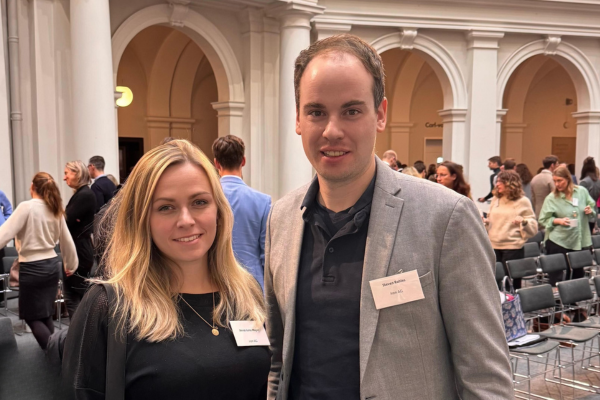
Also in November, we had the pleasure of participating in two exciting days at the Hamburg Forum of the Sustainability Reporting 2025 of the DRSC to participate. Together with representatives from business, politics, financial institutions and NGOs, we discussed the latest developments on the topic of CO2reporting, CSRD, and VSME.
There was considerable controversy surrounding the scope and thresholds for reporting. However, there was agreement on one key point: if the EU does not want to lose even more credibility, it must "finally settle down." The ongoing uncertainty with which the EU is leaving companies in the member states alone is leading to frustration and resignation among many of those affected.
Tanja Castor, Head of Sustainability Disclosures at BASF SE, brought up another important point in the panel discussion on the adjustments to CSRD and ESRS: "It is time for companies - regardless of the developments in Brussels - to get the topic of sustainability out of the bureaucratic corner into which the EU has pushed it in recent years. Sustainability must return to the corporate strategy, with a clear focus on the strategic benefits.
The clear approval of the participants in the hall showed that Ms. Castor had struck a chord with many ESG managers. This mood continued at the evening event. There is a palpable desire to really make a difference again, rather than complaining about the additional burden of excessive reporting.
Conclusion: Innovation through greater freedom
What remains from this journey through the ESG year 2025? A key insight that Professor Jochen R. Pampel from the University of Potsdam formulated at the BAUM conference: "The technology that took us into space was not planned by regulation, but arose from freedom for innovation. In the same way, we should also allow companies today a certain amount of freedom to develop innovation for sustainability."
This idea sums up what we learned during our event trip: ESG does not work as a one-size-fits-all solution. The perspectives are too different, the challenges too diverse. What is needed is less attention to detail in regulation and more room for entrepreneurial solutions. Because innovation can be a be an inspiring element for people to create something new - especially for a more sustainable future.


